
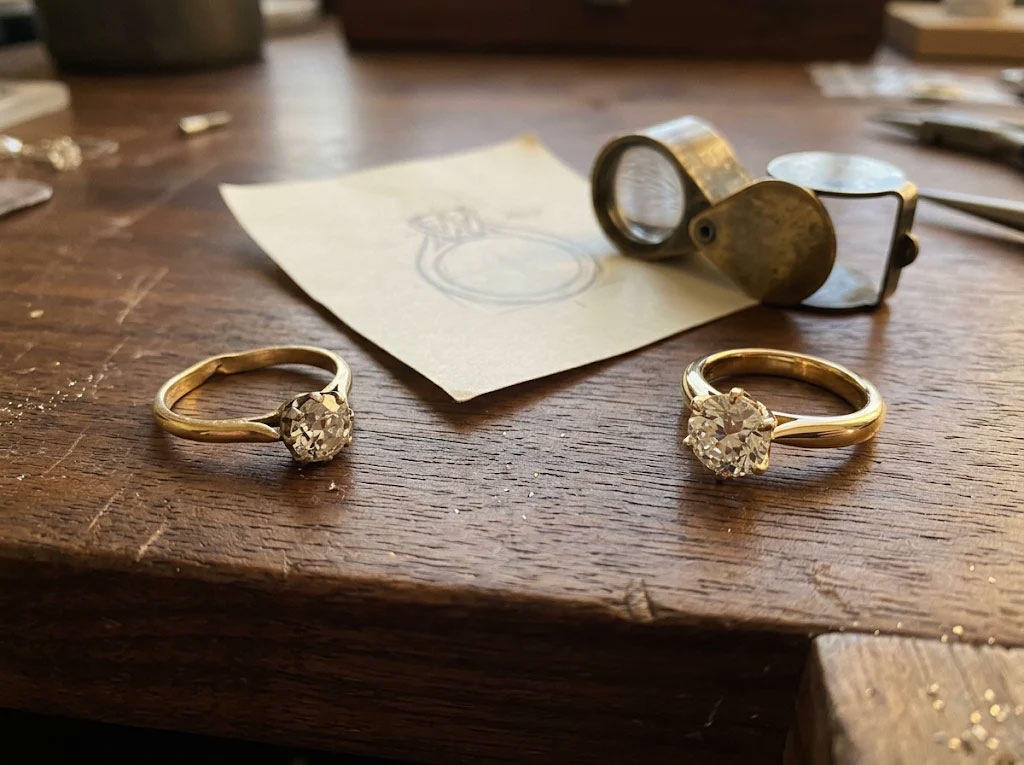
Heirloom Engagement Ring Redesign: Turning Grandma’s Ring Into Yours
What can be reused, how much gold an old ring really holds, and what a remake looks like from the day you bring it in.
Can grandma’s ring become your engagement ring? Usually, yes. Solid gold and platinum can be melted and reused, diamonds and sapphires move into new settings without trouble, and the pieces that can’t be reused are easy to spot once you know what to look for.
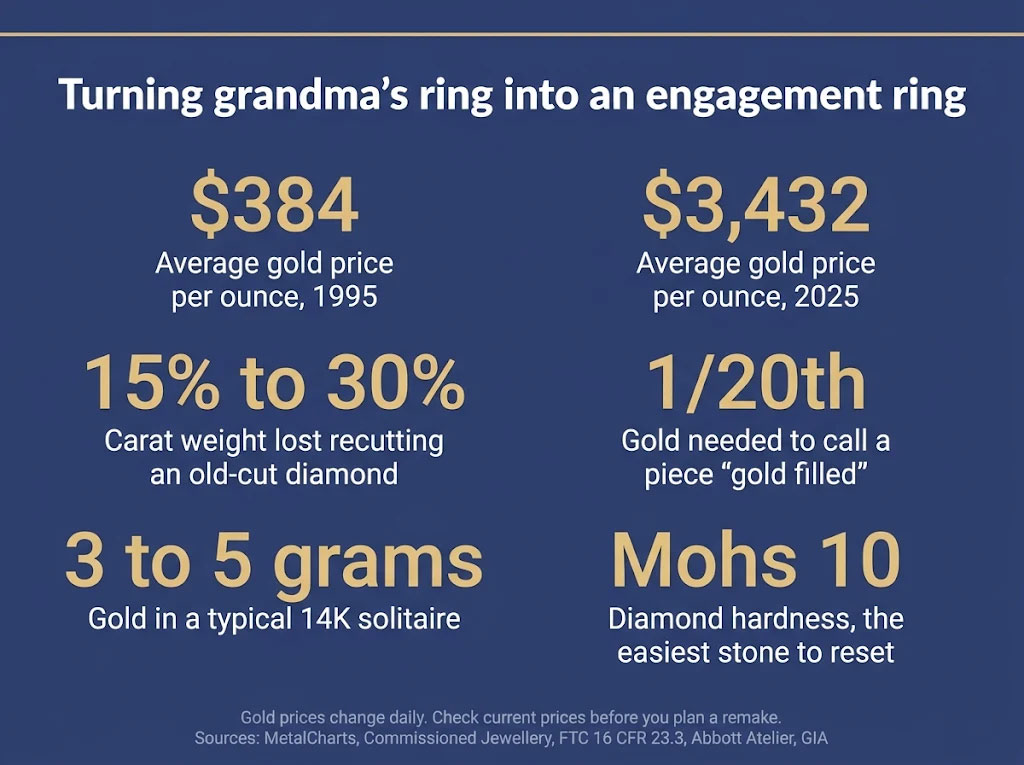
The timing has rarely been better. Gold averaged $384 an ounce in 1995 and $3,432 in 2025 (LBMA annual averages via MetalCharts). The metal sitting in a family jewelry box now costs far more to buy new than it did when it was made.
This guide covers what can be reused and what can’t, how much gold an old ring really holds, what to do with old-cut diamonds, and what a remake looks like from start to finish. The answers come from gemological and government sources, gold market data, and the bench at Nelson Estate Jewelers in Mesa, which has served the East Valley since 2016.
Key takeaways
- $384 to $3,432Average gold price per ounce in 1995 and in 2025. The same gold costs nearly nine times as much today. (MetalCharts)
- $4,262Average gold price per ounce in the third quarter of 2026, up 23% from a year earlier. (World Gold Council)
- 10 and 9Mohs hardness of diamond, and of sapphire and ruby. These are the stones that handle being unset and reset in a new ring. (GIA)
- 1/20thThe share of a piece’s metal weight that has to be gold before it can be called gold filled. There isn’t enough gold underneath to melt into a solid gold ring. (FTC Jewelry Guides, 16 CFR 23.3)
- 15% to 30%Carat weight typically lost when an old mine or old European cut diamond is recut to a modern round. (Commissioned Jewellery)
- 3 to 5 gramsTypical gold weight of a 14K solitaire engagement ring. Wedding bands run 5 to 8 grams. (Abbott Atelier, The Alloy Market)
Can You Turn Grandma’s Ring Into an Engagement Ring?
Yes, in most cases. You have four options, from lightest to fullest: wear the ring as it is, restore it, move only the stone into a new setting, or melt the gold and remake everything. The right one depends on the ring’s condition and how much you love its current style.
- Wear it as it is. A cleaning, a polish and a sizing may be all it needs.
- Restore it. New prongs, a rebuilt shank and a fresh finish keep the original design wearable for daily life.
- Reset the stone. Keep grandma’s diamond and move it into a new setting in a style you choose.
- Remake everything. Melt the family gold, reuse the stones, and build a new ring from the ground up.
Reusing gold isn’t new or unusual. The World Gold Council counted 314.5 tonnes of recycled gold out of 1,368.6 tonnes of total supply in the third quarter of 2026, or about 23% (World Gold Council, Q3 2026 supply). Family rings melted into new rings are a small, personal part of that same flow.
More families are about to face this choice. Cerulli Associates projects $124 trillion in wealth will change hands through 2048, with $105 trillion going to heirs (Cerulli Associates). For many couples, that inheritance includes a ring, a chain and a pair of earrings nobody wears. If you’re not sure what you’re holding, our guide to estate, vintage and antique jewelry explains the difference.
Wealth Cerulli Associates projects will pass to heirs through 2048. For many families, part of that inheritance is a jewelry box.
Cerulli Associates
Is it disrespectful to change a family ring? Most families see it the other way: a ring in a drawer isn’t honoring anyone. You also don’t have to choose all or nothing.
Many couples keep grandma’s diamond exactly as it is and change only the band, or turn the old band into a matching wedding ring so both pieces stay in the family. If you’re unsure what your partner would want, start with finding out what engagement ring your partner really wants.
What in Grandma’s Jewelry Box Can Be Reused?
Solid gold, platinum, diamonds, sapphires and rubies can almost always be reused. Gold-plated and gold-filled pieces can’t be melted into a gold ring. Emeralds, opals and pearls are soft or heat sensitive, so they need extra care and may suit a pendant better than an everyday ring.
| Material | Hardness or mark | Reuse in a new ring? |
|---|---|---|
| Diamond | Mohs 10 | Yes |
| Sapphire and ruby | Mohs 9 | Yes |
| Emerald | Mohs 7.5 to 8 | With care; many are treated and heat sensitive |
| Opal | Mohs 5 to 6.5 | Often better in a pendant or earrings |
| Pearl | Mohs 2.5 to 3 | Often better in a pendant or earrings |
| Solid gold | 10K, 14K, 18K or 417, 585, 750 | Yes, melt and reuse |
| Platinum | PT or PLAT | Yes |
| Gold filled or plated | GF, RGP, HGE, 1/20 | Metal no; real stones in it often yes |
Hardness: GIA. Gold filled rule: FTC Jewelry Guides, 16 CFR 23.3.
Start with the stones. Diamond scores 10 on the Mohs hardness scale, and sapphire and ruby both score 9 (GIA). Those are the stones that survive decades of daily wear and handle being unset and reset.
Emerald sits at 7.5 to 8, opal at 5 to 6.5 and pearl at just 2.5 to 3 (GIA). GIA also notes that filled emeralds can be damaged by heat and even by hot water from washing dishes (GIA, An Introduction to Gem Treatments). The heat of repair work is far hotter than that.
Then check the metal. Look inside the band for a stamp: 10K, 14K and 18K, or numbers like 417, 585 and 750, mean solid gold. PT or PLAT means platinum. Stamps like GF, RGP, HGE or 1/20 mean the gold is only a surface layer.
Under the FTC Jewelry Guides, a piece can be called gold filled when the gold layer is at least this share of the metal’s total weight. Plated pieces carry even less. Underneath is base metal, so it can’t become a gold ring.
FTC Jewelry Guides, 16 CFR 23.3
Finally, look at condition. Thin, flattened prongs, a band worn paper thin at the bottom, dark blobs of old solder and chipped stones don’t rule out a remake, but they change the plan. A good jeweler points all of this out at the counter, before you leave anything behind. Our jewelry repair bench handles retipping and rebuilding when a ring is worth restoring rather than remaking.
What Is Grandma’s Gold Worth Now? Nearly 9 Times Its 1995 Price
A lot more than when it was bought. Gold averaged $384 an ounce in 1995 and $3,432 in 2025, and the third quarter of 2026 averaged $4,262. The gold in a typical family wedding band would cost roughly ten times as much to buy new today as when grandma got it.
Here is the math on one ring. Gold is priced per troy ounce, which is 31.1 grams (Money Talks News). A 5 gram 14K wedding band is 58.3% gold (Washington Diamond), so it holds about 2.9 grams of pure gold, just under a tenth of an ounce.
- At the 1995 average of $384 an ounce, that gold cost about $36.
- At the 2025 average of $3,432, it was worth about $320.
- At the third quarter 2026 average of $4,262, it is close to $400.
One ring, same gold, roughly ten times the price. That is why reusing family gold makes sense right now. If you buy new, you pay today’s price for every gram in your ring. If you reuse what’s already in the family, the most expensive raw material is already paid for, and you’re paying for design and labor instead.
Gold prices move every day, so treat these figures as a snapshot and check the current price before you plan a project. The long-term direction since grandma’s era is clear. Our article on whether inherited jewelry is worth more than melt value covers the selling side of the same question.
Can You Use Grandma’s Diamond in a New Ring?
Yes, and it’s usually the best part of the project. A diamond can move into almost any modern setting. The one move to avoid is recutting an old-cut stone, which typically loses 15% to 30% of its carat weight along with the antique character that makes it special.
Diamonds from the early and mid 1900s are often old European or old mine cuts. They are rounder or cushion shaped, with a small table, a high crown and a softer, flashier sparkle than a modern round. Years ago, many were recut to look modern. Today that’s usually a mistake.
- Recutting an old mine or old European cut to a modern round typically loses 15% to 30% of its carat weight (Commissioned Jewellery)
- Diamondbanc reports a similar average loss of 15% to 25% (Diamondbanc)
Designing a new setting around the old cut keeps both the size and the history. Recutting is worth considering only when a stone is badly chipped. To understand how cut affects sparkle, see our guide to the 4Cs.
A natural family diamond also stands out more than it used to. In The Knot’s Real Weddings Study, 61% of engagement rings had a lab-grown center stone (The Knot Real Weddings Study). A natural diamond that has been in the family for generations is now the exception, not the rule.
Nelson Estate Jewelers works only with natural diamonds. We do not buy or sell lab-grown diamonds. Every diamond that comes through our Mesa store is tested, so you will know exactly what grandma’s stone is before any design work begins. Our natural versus lab diamond comparison explains how a jeweler tells them apart.
Small diamonds matter too. Tiny stones from old bands, earrings or cocktail rings make good accents around a bigger center stone, in a halo setting or a pavé band. It’s an easy way to fit several family pieces into one ring without changing the main stone.
Is There Enough Gold in Grandma’s Ring? Most Rings Need 3 to 8 Grams
Often, but not always. A 14K solitaire setting typically uses 3 to 5 grams of gold and a wedding band 5 to 8 grams. A worn, thin band from decades ago may fall short of a new design, while a heavy class ring or chain can cover it easily. Weighing the gold answers the question in seconds.
- Typical 14K diamond solitaire: 3 to 5 grams (Abbott Atelier)
- Typical wedding band: 5 to 8 grams (The Alloy Market)
- 4mm 14K wedding band: about 6 grams (deBebians)
Ring weights vary with width, thickness and size. Grandma’s ring may also have lost weight over the years, since bands wear thinnest at the bottom. If one ring isn’t enough, you can pool gold from other family pieces, such as a broken chain or a single earring, or the jeweler adds new gold to make up the difference.
What about mixing karats? 14K gold is 58.3% pure gold and 10K is 41.7% (Quantum Qarat). Jewelers can melt a 10K ring and a 14K ring together, but the result is an alloy somewhere in between (Reflective Jewelry).
To get a true 14K ring, the jeweler adds pure gold to bring the melt up to standard, known as plumb, so it can be honestly stamped (Walker Metalsmiths). Nelson Estate Jewelers can blend family gold up to the karat you want and will tell you what your finished ring will be before work starts.
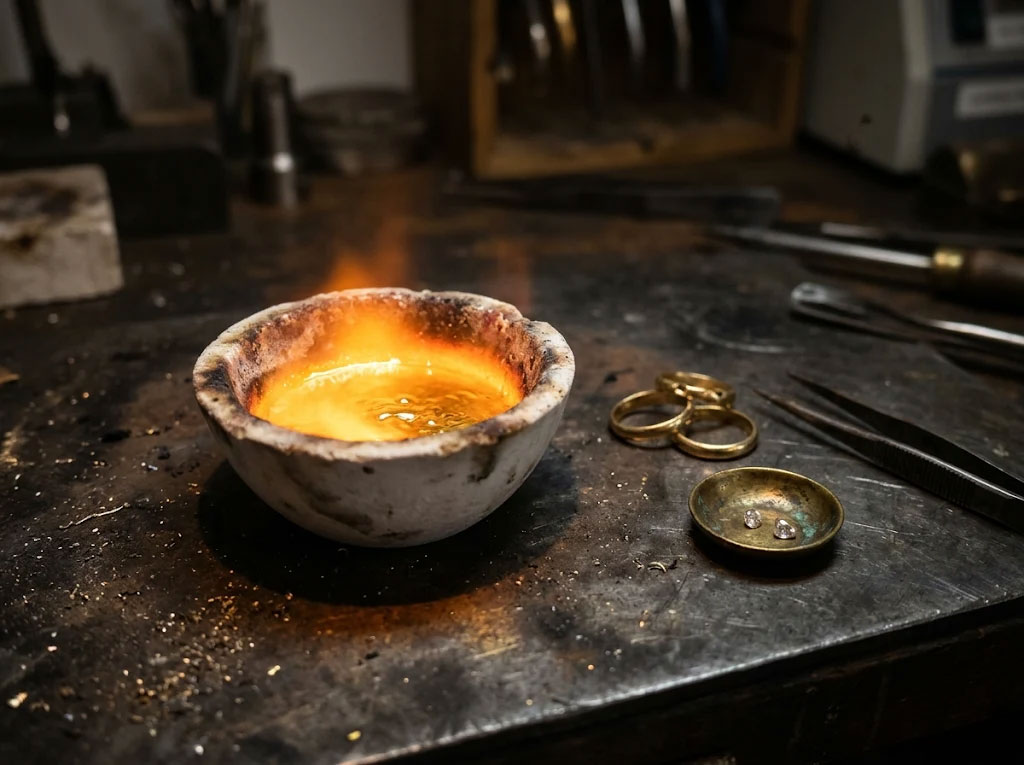
The melting itself is the easy part. 14K gold melts at about 1,615°F and 18K at about 1,700°F (Fire Mountain Gems). Every stone comes out first, since most gems can’t take that heat. If you’re making matching bands from family gold, see our guide to his and hers wedding bands for width and style ideas.
What Happens When You Bring It In? About 4 to 8 Weeks, Start to Finish
You bring the pieces in, the jeweler checks every stone and weighs and tests the gold at the counter, and you agree on a design before anything is melted. Most heirloom remakes take about 4 to 8 weeks, depending on how much work the old pieces need.
- Counter check. Before you leave anything, you hear what’s possible: whether there is enough gold, whether any stones are chipped or loose, whether a piece is a lower karat than you thought, and whether old solder or worn prongs need attention. If you’ll need extra gold or a new diamond, you know right then.
- Take-in receipt. Every piece you leave is written up: each item described, the gold weighed, the stones measured and photographed, so what comes back matches what went in.
- Design. You talk through styles, look at sketches and settle on the finished look before any metal is touched.
- Bench work. Stones are removed, the gold is tested, melted and refined if needed, the new ring is cast or built, and the stones are set and polished.
- Pickup. Any gold left over is returned to you or credited toward the job.
Simple resets move faster. Jobs that start with old gold and old diamonds take longer than a ring built from new materials. At Nelson Estate Jewelers, all of it happens in-house at our Mesa shop, so your family pieces never leave the building (Nelson Estate Jewelers). Learn more about our custom jewelry design process.
If a piece may be worth several thousand dollars, get an appraisal first. Nelson offers complimentary verbal appraisals in Mesa with no appointment, and refers written insurance appraisals to independent appraisers who hold GIA Graduate Gemologist credentials (Nelson Estate Jewelers). Update the appraisal after the remake so your new ring is covered. Our guide to engagement ring insurance explains why.
Trust matters when you hand over a family ring. Nelson Estate Jewelers was the first jewelry store in Arizona history to win the BBB Torch Award for Ethics (Nelson Estate Jewelers).
Bring grandma’s ring to our Mesa store
No appointment is needed. We check every stone, weigh and test the gold in front of you, and talk through what your family pieces can become. Nelson Estate Jewelers has served Mesa since 2016, and owner David has more than 30 years in the jewelry trade. If you decide to sell pieces you don’t reuse, we typically pay more than mall jewelry stores for solid gold, silver and natural diamonds.
Visit1862 W. Baseline Road, Suite 101
Mesa, AZ 85202
HoursTuesday to Friday, 10 am to 6 pm
Saturday, 10 am to 5 pm
Closed Sunday and Monday
Directions or questions(480) 459-9867
Serving Mesa, Tempe, Chandler, Gilbert, Scottsdale, Apache Junction, Queen Creek and the East Valley.
Explore Every Figure in This Article
| Metric | Value | Period | Source |
|---|---|---|---|
| Recycled gold supplied in one quarter (tonnes) | 314.5 | Q3 2026 | World Gold Council |
| Total gold supply in the same quarter (tonnes) | 1,368.6 | Q3 2026 | World Gold Council |
| Wealth projected to transfer through 2048 | $124 trillion | Projection | Cerulli Associates |
| Portion expected to go to heirs | $105 trillion | Projection | Cerulli Associates |
| Diamond hardness (Mohs) | 10 | Standard | GIA |
| Sapphire hardness (Mohs) | 9 | Standard | GIA |
| Ruby hardness (Mohs) | 9 | Standard | GIA |
| Emerald hardness (Mohs) | 7.5 to 8 | Standard | GIA |
| Opal hardness (Mohs) | 5 to 6.5 | Standard | GIA |
| Pearl hardness (Mohs) | 2.5 to 3 | Standard | GIA |
| Minimum gold share of metal weight to be called gold filled | 1/20th | Federal rule | FTC Jewelry Guides, 16 CFR 23.3 |
| Average gold price per ounce | $161 | 1975 | LBMA via MetalCharts |
| Average gold price per ounce | $615 | 1980 | LBMA via MetalCharts |
| Average gold price per ounce | $383 | 1990 | LBMA via MetalCharts |
| Average gold price per ounce | $384 | 1995 | LBMA via MetalCharts |
| Average gold price per ounce | $279 | 2000 | LBMA via MetalCharts |
| Average gold price per ounce | $444 | 2005 | LBMA via MetalCharts |
| Average gold price per ounce | $1,225 | 2010 | LBMA via MetalCharts |
| Average gold price per ounce | $1,770 | 2020 | LBMA via MetalCharts |
| Average gold price per ounce | $3,432 | 2025 | LBMA via MetalCharts |
| Average gold price per ounce, quarterly | $4,262 | Q3 2026 | World Gold Council |
| Year-over-year rise in the quarterly gold price | 23% | Q3 2026 | World Gold Council |
| Grams in one troy ounce | 31.1 | Standard | Money Talks News |
| Engagement rings with a lab-grown center stone | 61% | 2025 | The Knot Real Weddings Study |
| Carat weight lost recutting an old mine or old European cut | 15% to 30% | Typical range | Commissioned Jewellery |
| Average weight loss recutting antique cuts, second estimate | 15% to 25% | Typical range | Diamondbanc |
| Typical 14K diamond solitaire weight | 3 to 5 grams | Typical range | Abbott Atelier |
| Typical wedding band weight | 5 to 8 grams | Typical range | The Alloy Market |
| 4mm 14K wedding band weight | 6 grams | Typical | deBebians |
| Gold content of 14K | 58.3% | Standard | Washington Diamond |
| Gold content of 10K | 41.7% | Standard | Quantum Qarat |
| Melting point of 14K gold (°F) | 1,615 | Standard | Fire Mountain Gems |
| Melting point of 18K gold (°F) | 1,700 | Standard | Fire Mountain Gems |
Frequently Asked Questions
Can you turn your grandmother’s ring into an engagement ring?
Usually, yes. Solid gold and platinum can be melted and reused, and diamonds, sapphires and rubies survive being moved into a new setting. What decides it is condition: worn prongs, thin bands, old solder or plated metal. A jeweler should check all of that in front of you before you commit.
How long does it take to redesign an heirloom ring?
Most heirloom remakes take about 4 to 8 weeks, depending on how much work the old piece needs. Removing old stones, melting and refining family gold, and casting a new design take longer than building a ring from new materials. At Nelson Estate Jewelers in Mesa, all of that work is done in-house, so nothing is shipped out.
Can you use grandma’s diamond in a new setting?
Yes. Diamond is the hardest gemstone at 10 on the Mohs scale, so it handles being unset and reset well. The jeweler checks it for chips first, measures it and builds the new setting around its exact size. Old-cut diamonds can look beautiful in modern settings without being recut.
Can you melt down old gold rings to make a new ring?
Yes. Solid gold can be melted and recast many times, and 14K gold melts at about 1,615°F. Before melting, every stone is removed and the karat is tested. The new ring is cast or built from that metal, with extra gold added if the design needs more.
Can you mix 10K and 14K gold in one ring?
Yes. Jewelers can melt a 10K ring with a 14K ring, but the result is an alloy somewhere in between. If you want the new ring to be a true 14K, the jeweler adds pure gold to bring the mix up to standard so it can be honestly stamped. Ask what karat your finished ring will be.
Is there enough gold in one old ring to make a new one?
Often, but not always. A typical 14K solitaire setting uses 3 to 5 grams of gold and a wedding band 5 to 8 grams. A thin, worn band from decades ago may weigh less than the new design needs, while a heavy class ring or chain can supply plenty. Weighing the gold answers it in seconds.
What happens if there isn’t enough gold in grandma’s ring?
The jeweler tops it up with new gold of the same karat, or adds pure gold to raise a lower-karat mix, so the finished ring can be honestly marked. You can also pool gold from other family pieces, such as a broken chain or a single earring. You should know before work starts how much needs adding.
Can gold-plated or gold-filled jewelry be remade into a ring?
Not as gold. Under the FTC Jewelry Guides, gold filled only requires a gold layer equal to 1/20th of the metal’s weight, and plating is thinner still. Underneath is brass or another base metal. Stones from these pieces can often be reused, but the metal can’t be melted into a solid gold ring.
Can you reuse emeralds, opals or pearls in a new ring?
Sometimes, with care. GIA rates opal 5 to 6.5 and pearl 2.5 to 3 on the Mohs scale, and notes that filled emeralds can be damaged even by hot dishwater. These stones can crack or dry out from the heat of repair work and wear down on a daily ring. A pendant or earrings may suit them better.
Should you recut an old European or old mine cut diamond?
Usually not. Recutting an old cut to a modern round typically loses 15% to 30% of its carat weight and erases the antique character that makes it special. A new setting designed around the old cut keeps the size and the history. Recut only if the stone is badly chipped.
Is it disrespectful to redesign a family heirloom ring?
Most families see it as the opposite: the ring gets worn again instead of sitting in a drawer. Cerulli Associates projects $105 trillion will pass to heirs through 2048, so more families will face this choice. You don’t have to change everything. You can wear it as is, restore it, move only the stone, or remake it fully.
What if my fiancée doesn’t like grandma’s ring style?
Keep the meaning and change the look. The most common fix is keeping the family diamond and setting it in a style she loves, then turning the old band into a matching wedding band or a keepsake. A typical new solitaire setting needs only 3 to 5 grams of gold, so the old metal often covers it.
Can you combine several family rings into one?
Yes. Jewelers routinely melt rings together, even different karats such as 10K and 14K, and reuse the stones from each. Grandma’s center diamond can sit beside stones from mom’s ring, or every piece of gold can go into one new band. Tell the jeweler which pieces matter most so they stay visible.
Can grandma’s small diamonds be used around a bigger center stone?
Yes. Small diamonds from old bands, earrings or cocktail rings make good accents in a halo, as side stones or in a pavé band around a main diamond. Because diamond rates 10 on the Mohs scale, even tiny stones survive being unset and reset. It’s a simple way to include several family pieces in one ring.
Can you make matching wedding bands from family gold?
Yes, if there’s enough gold. A 4mm 14K band weighs about 6 grams, so two bands can take more than one old ring supplies. Many couples pool gold from several family pieces, or reuse what they have and add new gold to finish both bands in the same karat and color.
Is redesigning cheaper than buying a new engagement ring?
Often, because you’re not buying the materials. Gold averaged $384 an ounce in 1995 and $3,432 in 2025, so reusing family gold and a family diamond covers the most expensive parts of a new ring. You still pay for design and labor, and old pieces that need a lot of repair cost more.
Do I need an appraisal before redesigning grandma’s ring?
For valuable pieces, yes. Start with a free verbal appraisal. Nelson Estate Jewelers offers complimentary verbal appraisals in Mesa with no appointment. If the piece is likely worth several thousand dollars, get a written appraisal from an independent GIA Graduate Gemologist before the remake, then update it afterward so your insurance covers the new ring.
Does Nelson Estate Jewelers work with lab-grown diamonds?
No. Nelson Estate Jewelers in Mesa works only with natural diamonds and does not buy or sell lab-grown stones. Every diamond that comes through the store is tested, so you will know exactly what a family stone is before any redesign begins. Call (480) 459-9867 with questions.
Where can I redesign an heirloom ring in Mesa?
Nelson Estate Jewelers at 1862 W. Baseline Road, Suite 101, Mesa, AZ 85202 checks family rings, tests the gold and stones, and handles redesign work in its own shop, with no appointment needed. Hours are Tuesday to Friday, 10 am to 6 pm, and Saturday, 10 am to 5 pm. Call (480) 459-9867 for directions or questions.
How We Built This Article
- It answers one question with public data: what in a family jewelry box can become a new engagement ring.
- Gem hardness and treatment come from GIA, the gold filled rule from the FTC Jewelry Guides, gold prices from LBMA averages and the World Gold Council.
- Ring weights, karat mixing and recut weight loss come from jeweler references. They are typical ranges, not a survey.
- Timelines and shop practices come from Nelson Estate Jewelers.
- No public survey measures how many couples use heirloom rings, so this article does not quote one.
- Gold prices change daily. Check the current price before you plan a project.
Sources
- LBMA annual averages via MetalCharts. Gold price history and averages.
- World Gold Council. Gold Demand Trends, Q3 2026.
- World Gold Council. Gold Demand Trends, Q3 2026: Supply.
- Money Talks News. Gold is off its record but still pays: Here’s the math on the old jewelry in your drawer.
- Cerulli Associates. Cerulli Anticipates $124 Trillion in Wealth Will Transfer Through 2048.
- GIA. Diamond, Sapphire, Ruby, Emerald, Opal and Pearl reference pages.
- GIA. An Introduction to Gem Treatments.
- U.S. Federal Trade Commission. Jewelry Guides, 16 CFR 23.3: Misrepresentation as to gold content.
- Washington Diamond. 14 Karat Gold Ring With Diamonds Value.
- Quantum Qarat. 10K vs 14K vs 18K Gold: The Ultimate Gold Purity Guide.
- Fire Mountain Gems. Metal melting point charts.
- Abbott Atelier. How Much Does a Ring Weigh?
- The Alloy Market. How Many Grams of Gold Are in a Ring?
- deBebians. Ring Weight.
- Walker Metalsmiths. Re-use Your Gold.
- Reflective Jewelry. Reusing Old Gold to Make a New Wedding Ring.
- The Knot Worldwide. 2026 Real Weddings Study.
- Commissioned Jewellery. Antique Cuts: Keep or Recut?
- Diamondbanc. Antique Diamond Cuts Value.
- Nelson Estate Jewelers. Jewelry Appraisal Services.
- Nelson Estate Jewelers. BBB Torch Award for Ethics.
This article is general information, not a guarantee of what any specific piece can become. Every heirloom is different, so the right plan depends on an in-person inspection of the metal and stones. Gold prices change daily.


